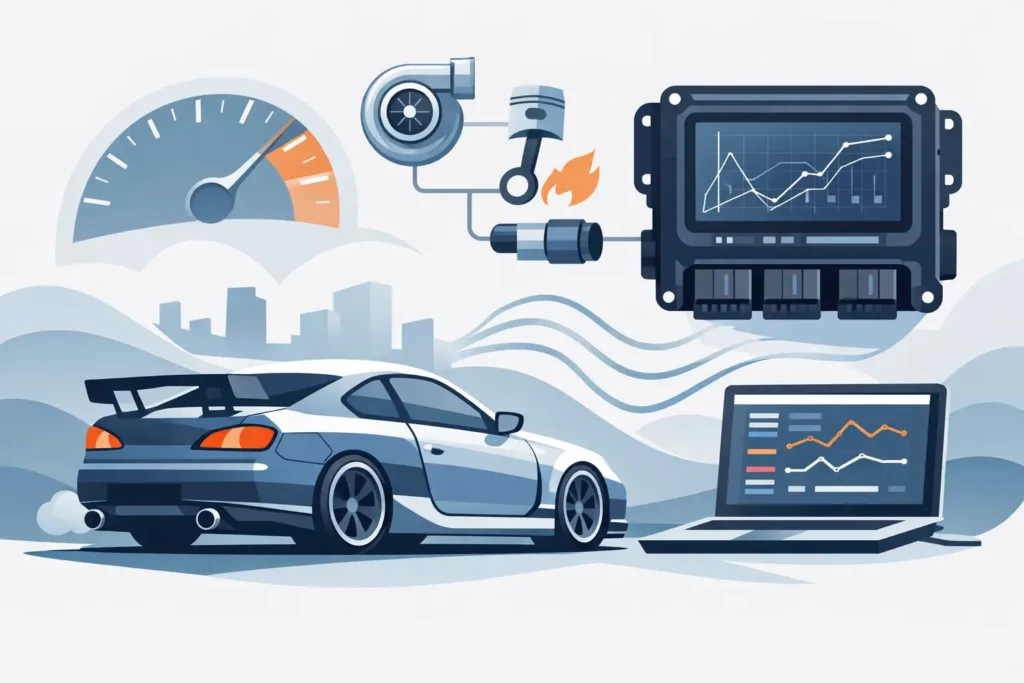
A larger intercooler, freer-flowing exhaust or upgraded intake can make a real difference – but only if the ECU understands the new hardware. A custom ECU tune for modified cars is not simply about requesting more boost or chasing a peak BHP figure. It is about calibrating fuelling, ignition, torque control and protection strategies around the vehicle as it stands today.
For a modified petrol car, diesel performance vehicle or working van, that distinction matters. The wrong calibration can leave power on the table, create inconsistent drivability or place unnecessary stress on components already operating beyond their original factory parameters. The right one should make the vehicle feel purposeful, predictable and usable in normal Hampshire traffic as well as under full load.
Why an off-the-shelf remap may not suit modified hardware
A Stage 1 calibration is often designed for a standard, healthy vehicle using standard supporting components. It can be an excellent route for owners who want stronger torque, sharper response and improved overtaking performance without mechanical changes.
Once hardware has changed, however, the factory airflow and thermal assumptions may no longer apply. An upgraded turbo, sports catalyst, intercooler, injectors, intake system or high-flow fuel pump can alter how the engine achieves and holds its targets. Even parts marketed for the same model can perform differently depending on their installation, condition and the ECU software version.
A generic file may still run, but running is not the same as being correctly calibrated. The ECU needs suitable targets and limiters for the airflow available, the fuel system capacity, exhaust gas temperature control and drivetrain torque tolerance. On modern vehicles, torque modelling is especially important. If requested torque, delivered torque and ECU safety limits do not agree, the car may reduce power, generate faults or feel uneven through the rev range.
What a custom ECU tune for modified cars should address
The aim is not to disable safeguards or force maximum output at every opportunity. A properly considered calibration works with the ECU’s control systems while adapting them to the installed hardware and the owner’s intended use.
On turbocharged petrol engines, this commonly means reviewing boost target behaviour, wastegate control, ignition timing, lambda targets, knock response and intake-air-temperature compensation. A car that makes an impressive number on a cool day but repeatedly pulls timing in warmer conditions is not delivering dependable performance.
On diesel engines, the focus often includes boost control, fuelling duration, rail pressure, smoke limitation, torque delivery and EGT management. This is particularly relevant for vans and commercial vehicles. A useful tune should improve loaded pulling power and reduce unnecessary gear changes without producing excessive smoke, harsh low-rpm torque or avoidable strain on a clutch, dual-mass flywheel or gearbox.
The calibration also needs to reflect the supporting parts honestly. A larger intercooler may allow intake temperatures to remain more stable under repeated acceleration, but it does not automatically mean every boost or fuelling limit should be increased. Likewise, a noisy intake does not always represent a meaningful airflow improvement. Decisions should be based on live data and the vehicle’s actual response, not a parts list alone.
Diagnostics first: the condition of the car comes before the file
Modified cars can mask developing faults surprisingly well. A boost leak may be mistaken for turbo lag. A tired coil pack can look like a fuelling issue. A restricted DPF, failing sensor, worn spark plugs or weak fuel supply can make a healthy calibration appear unsuitable.
That is why pre-remap checks are central to responsible tuning. Before software changes, a technician should assess fault codes, ECU information and relevant live data. Depending on the engine, this can include requested versus actual boost, fuel pressure, lambda readings, ignition correction, air mass, intake temperatures, DPF differential pressure and regeneration history.
These checks do not turn a mobile appointment into a full engine rebuild inspection, and they cannot guarantee that a component will never fail. They do provide a sensible engineering baseline. If the data identifies a problem, resolving it before tuning is usually cheaper than finding it after additional torque and cylinder pressure have exposed it.
For older or higher-mileage vehicles, the decision may be to use a more conservative calibration. That is not a compromised service. It is vehicle-specific tuning: matching the outcome to maintenance history, mileage, fuel quality, clutch condition and how the car is actually driven.
Supporting modifications need a sensible order
Many owners fit parts gradually, which is completely reasonable. The key is to plan the tune around what is fitted now and what is likely to change next.
If an upgraded turbo or fuel system is planned shortly, it can be more cost-effective to wait rather than calibrate twice. If the vehicle has already received the main supporting hardware, a custom calibration can be built around that package. The important point is to avoid treating every modification as an automatic power increase.
Some changes are primarily about reliability or consistency. An improved intercooler, for example, can reduce heat soak and help the engine maintain performance during repeated acceleration. Better tyres and brakes may do more for real-world confidence than a final small increase in peak power. On manual cars, clutch capacity deserves an honest conversation before a large torque increase is requested.
For road vehicles, modifications must also remain compliant with applicable construction, emissions, MOT, insurance and manufacturer requirements. Emissions-control faults should be diagnosed and repaired properly. Removing or bypassing emissions equipment is not a substitute for fixing the underlying issue.
Peak figures matter less than controlled torque delivery
BHP and torque figures are useful reference points, but they are not the whole driving experience. A well-calibrated car should respond cleanly from part throttle, build power progressively and deliver torque where the engine, gearbox and traction can use it.
An aggressive low-rpm torque spike may sound attractive, particularly on a diesel, yet it can overwhelm the tyres and drivetrain while making town driving less refined. In many cases, a smoother torque curve is faster and easier to live with. It can also be kinder to a clutch, gearbox and driveshafts.
The same applies to boost. More boost is only useful when the turbo is operating efficiently, the charge air remains controlled and the fuel and ignition strategy supports it. Past a certain point, additional boost may create more heat than meaningful power. Good calibration is often about knowing where that point is and leaving an appropriate margin.
Fuel, maintenance and daily use still set the limits
A custom tune is built around assumptions, including the fuel the car will regularly use. If a petrol calibration is intended for premium unleaded, consistently filling with lower-octane fuel can reduce the available knock margin. Modern ECUs can often protect the engine by adjusting timing, but that is not a reason to ignore the fuel requirement.
Routine maintenance matters just as much. Fresh oil of the correct specification, appropriate spark plugs, clean filters, sound hoses and a healthy cooling system all support reliable tuned operation. On diesels, attention to DPF health, boost plumbing and injector performance is particularly worthwhile.
Drivers should also allow the engine to warm through before demanding full power and avoid repeated hard use when warning lights, unusual smoke, misfires or temperature concerns are present. Tuning should make a well-maintained vehicle more capable, not turn maintenance into an afterthought.
Choosing the right approach for your vehicle
A custom calibration is most valuable when there is a clear reason for it: meaningful hardware changes, a non-standard turbo setup, a vehicle with a specific towing or commercial-use requirement, or an owner who wants controlled performance rather than a one-size-fits-all result.
For a standard vehicle, a proven Stage 1 or Stage 2 option may be the more practical choice. For a modified car, the technician should first establish the ECU type, installed hardware, diagnostic condition and realistic outcome. Final gains vary because every engine, turbocharger, fuel system and drivetrain has its own condition and tolerance.
Boostcore brings that assessment to your home, workplace or agreed location across Southampton and the surrounding area. The useful question is not simply, “How much power can it make?” It is, “What can this particular vehicle deliver reliably, with the parts fitted and the way it is used?” That is where a custom ECU tune earns its value.