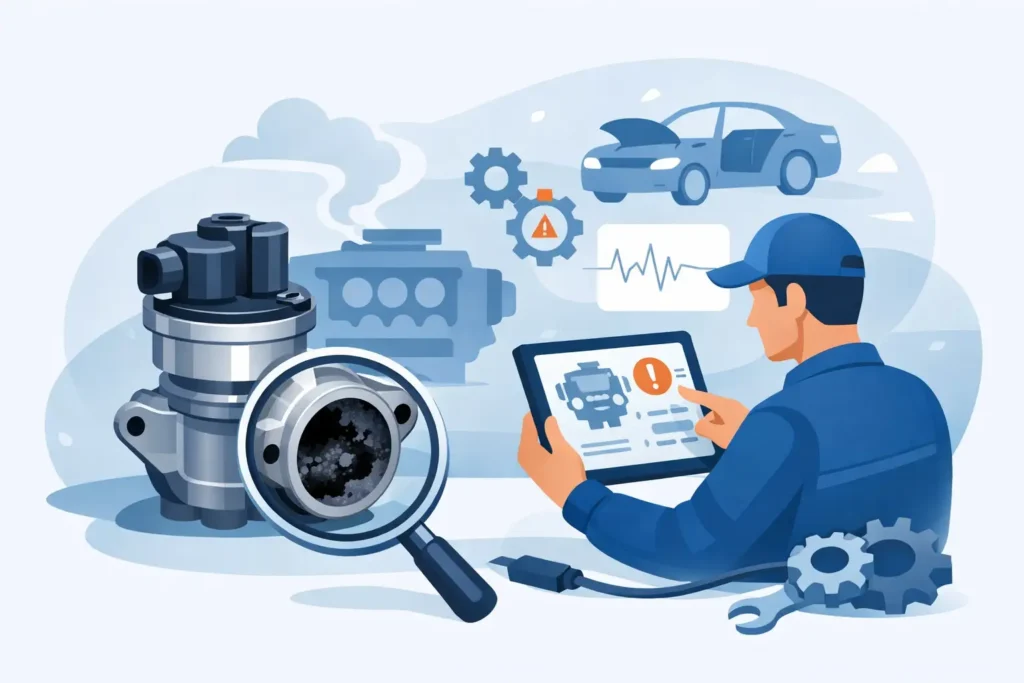
A warning light and an EGR-related fault code do not automatically mean the EGR valve itself has failed. An effective EGR valve fault diagnosis service identifies why the ECU has logged the fault before parts are replaced, software is altered or a vehicle is taken out of work unnecessarily. That distinction matters on everything from a daily diesel saloon to a hard-worked Transit, Vivaro or Sprinter.
The EGR system is part of the engine’s emissions strategy. It recirculates a controlled amount of exhaust gas back into the intake under specific operating conditions, helping to reduce combustion temperatures and nitrogen oxide emissions. When the system cannot achieve the flow the ECU expects, or when its position feedback does not agree with the command, performance, economy and drivability can all be affected.
At Boostcore, diagnostics come before recommendations. A mobile assessment can be carried out at your home, workplace or another suitable agreed location across Southampton, Hampshire and surrounding areas, provided the vehicle is safe to inspect and test.
What an EGR valve fault diagnosis service should establish
The useful question is not simply, “Is the EGR valve faulty?” It is whether the vehicle has a valve control issue, an airflow issue, an exhaust-side restriction, a wiring fault, or a condition elsewhere that is causing an EGR plausibility code.
Modern diesel and petrol engines use several inputs to monitor EGR operation. Depending on the vehicle, the ECU may compare EGR valve position with requested position, use MAF readings to calculate airflow change, monitor inlet manifold pressure, check exhaust pressure or calculate expected combustion behaviour from lambda and temperature data. One stored code rarely tells the full story.
For example, a code indicating insufficient EGR flow may be caused by carbon restriction in the valve or cooler. It can also appear when a boost leak, contaminated MAF sensor, split vacuum pipe, sticking intake flap or DPF back-pressure problem changes the airflow figures the ECU expects to see. Replacing the EGR valve without checking those conditions can leave the original fault unresolved.
Likewise, an electrical EGR code may point towards the valve motor or internal position sensor, but it can also be caused by damaged wiring, water ingress at a connector, poor power supply or a fault in the relevant ECU control circuit. The repair route depends on evidence, not assumptions.
Common signs of an EGR system problem
An EGR fault does not always produce obvious symptoms at first. Some vehicles continue to drive reasonably well while the ECU stores an intermittent code. Others enter reduced-power mode because the engine cannot control airflow or emissions as intended.
Drivers and fleet operators often report a flat spot during acceleration, rough idle, hesitation at low revs, increased smoke on diesel engines, poor fuel economy or repeated engine management warnings. A vehicle may also feel reluctant when pulling away with a load, particularly where low-end torque is essential for daily commercial use.
These signs are not exclusive to the EGR system. Similar behaviour can result from DPF loading, boost leaks, injector correction issues, intake contamination, faulty pressure sensors or turbo actuator problems. That is why fault-code reading alone is not a diagnosis.
Why short journeys can make the issue worse
Diesel engines used mainly for short, low-load journeys are more likely to accumulate soot in the intake and EGR circuit. The engine may not regularly reach the exhaust temperatures needed to support efficient DPF regeneration, while stop-start use creates frequent low-speed operating conditions where EGR activity is common.
That does not mean every town-driven diesel will develop an EGR fault, and long motorway use is not a guaranteed cure once a component is sticking or heavily restricted. Driving pattern, servicing quality, oil specification, mileage and the condition of the wider air and exhaust system all influence the result.
The diagnostic process: codes, live data and physical checks
A proper assessment begins with the vehicle’s history and current symptoms. It helps to know whether the warning light is permanent or intermittent, whether limp mode occurs under load, what repairs have already been attempted and whether the fault appeared after a battery issue, DPF warning or intake repair.
Dealer-level diagnostic equipment is then used to read stored, pending and historic fault codes, together with freeze-frame information where available. Freeze-frame data can show the engine speed, coolant temperature, load and other operating values when the fault was recorded. A code logged at cold idle needs interpreting differently from one triggered at sustained motorway load.
Live-data assessment follows. Relevant values may include commanded and actual EGR position, MAF measured versus expected airflow, manifold absolute pressure, boost request and actual boost, DPF differential pressure, exhaust gas temperatures, coolant temperature and lambda data. The exact list varies by engine and ECU, but the aim remains the same: establish whether the readings make engineering sense.
Where the ECU supports it, actuator tests can command the EGR valve through its operating range. A response test may reveal a valve that fails to move, moves slowly, reports an implausible position or operates electrically but does not produce the expected airflow change. On vacuum-operated systems, the vacuum supply, control solenoid and pipework also need checking.
A visual inspection can be equally valuable. Loose intake hoses, oil contamination around boost pipes, damaged connectors, rubbed-through wiring and obvious exhaust leaks can all affect diagnostic results. If access allows, checks around the EGR valve, cooler and intake path may identify heavy carbon build-up or evidence of coolant loss from an EGR cooler issue.
When an EGR fault is actually a DPF or boost problem
EGR and DPF faults frequently overlap because both systems depend on sensible exhaust flow and accurate sensor data. Excessive DPF pressure can alter operating conditions and contribute to repeated emissions-related faults. Conversely, poor combustion, boost leaks or injector concerns can increase soot production and place the DPF under greater load.
A van that repeatedly reports an EGR flow fault while struggling to regenerate may need its DPF pressure readings assessed before any EGR component is condemned. A diesel car with a split intercooler hose may show airflow values that lead the ECU towards an EGR plausibility fault, even though the valve is not the root cause.
This is also where maintenance history matters. A vehicle with overdue servicing, incorrect oil, a known boost leak or frequent aborted regenerations needs a broader health check. Clearing the code may restore normal operation briefly, but it does not correct the condition that made the ECU log it.
Repair-focused recommendations, not automatic part replacement
Once the evidence is clear, the next step may be a repair, cleaning where appropriate, wiring repair, replacement of a related sensor or further investigation of the intake, turbo or DPF system. The right answer depends on the engine design, access, degree of contamination and whether the component has suffered an electrical or mechanical failure.
EGR valve cleaning can be worthwhile on some vehicles where soot contamination is confirmed and the valve mechanism remains serviceable. It is not a universal fix. A failed motor, worn position sensor, damaged cooler or valve that is mechanically seized may require replacement instead. On certain engines, removal work is substantial, so an accurate diagnosis before authorising labour is particularly valuable.
Any emissions-system work should be approached responsibly. Removing, bypassing or disabling emissions control equipment can create legal, MOT, insurance and environmental problems for a road-going vehicle. The sensible route is to identify the defect and restore correct operation with a repair plan suited to the vehicle’s use.
Why diagnostics matter before ECU tuning
A Stage 1 or custom ECU calibration should not be used to mask an engine management fault. A healthy vehicle responds more predictably to calibration changes, while an existing airflow, DPF, sensor or EGR problem can compromise drivability and place additional stress on components under increased torque demand.
For vehicles being considered for tuning, an EGR-related warning or stored code should be investigated first. Live-data checks can reveal whether the engine is controlling boost, airflow and exhaust conditions correctly before software changes are discussed. This is especially relevant for high-mileage diesels, commercial vehicles and cars that have been modified previously.
Vehicle-specific recommendations are more useful than generic promises. Engine condition, ECU software version, mileage, intended use, fuel quality and maintenance record all affect what is sensible. A work van that needs reliable pulling power every day has different priorities from a weekend performance car.
Arrange a mobile EGR diagnostic assessment
If your engine management light is on, the vehicle has lost power or an EGR code keeps returning after it has been cleared, start with evidence rather than a replacement part. Bring any previous diagnostic reports and note when the fault occurs, particularly whether it appears cold, under acceleration, during motorway driving or with a load.
A methodical EGR assessment can protect you from spending money in the wrong place and help keep a car or commercial vehicle dependable for the journeys that matter.