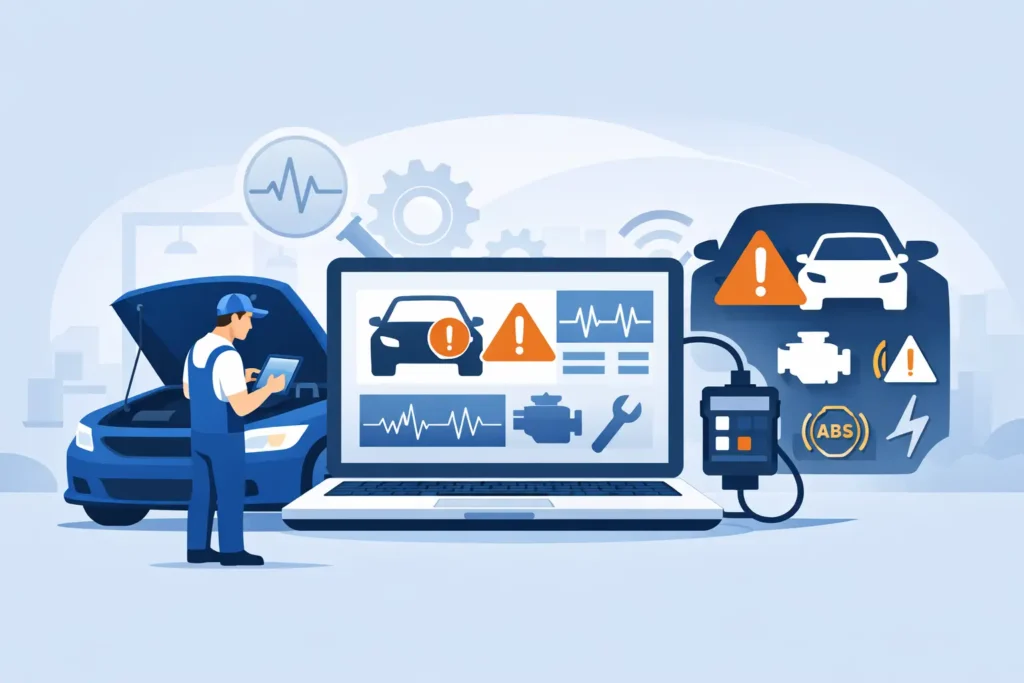
A warning light can arrive on the school run, halfway through a delivery round or just before a long motorway journey. The immediate question is usually, “how are vehicle fault codes diagnosed?” The useful answer is not simply “plug in a scanner”. A fault code is a starting point that tells a technician which ECU system has seen an implausible signal or operating condition. Finding the reason requires context, testing and evidence.
For a petrol car, diesel, van or fleet vehicle, this distinction matters. Replacing a component because its code appeared can be expensive and ineffective. A proper diagnostic process identifies whether the issue is the sensor itself, its wiring, an air leak, a blocked DPF, a fuel-delivery problem, low system voltage or another fault affecting the same calculation.
How Are Vehicle Fault Codes Diagnosed in Practice?
Modern vehicles use multiple control modules. The engine ECU is the most familiar, but fault information may also sit in the transmission control unit, ABS module, body control module, airbag system, battery-management system and AdBlue or emissions-control module. Dealer-level diagnostic equipment communicates with these modules, reads their diagnostic trouble codes, records their status and accesses relevant live data.
A diagnostic trouble code, commonly called a DTC, normally has a letter and four numbers. For example, a P code relates to the powertrain. A code such as P0299 may point towards underboost, while P0101 can relate to a mass air flow reading that is outside the ECU’s expected range. Neither code automatically condemns a turbocharger or mass air flow sensor.
The ECU has detected a result, not necessarily the root cause. Underboost may be caused by a split intercooler hose, sticking turbo actuator, vacuum leak, boost-control solenoid issue, exhaust restriction, sensor error or a genuine turbo fault. The correct repair depends on what the vehicle’s readings and physical condition show.
1. Start with the complaint and vehicle history
A code read should begin with the driver’s description of the problem. Is the engine-management light permanently on, or did it appear once and disappear? Is there reduced power under load, rough idle, poor fuel economy, difficult starting, smoke, limp mode or an intermittent warning? On a commercial vehicle, it is equally useful to know whether the fault appears with a loaded trailer, on cold starts or after repeated short journeys.
Service history can narrow the investigation. A recently replaced battery may explain low-voltage communication codes. A vehicle used mainly for short local runs may be more vulnerable to DPF loading. A car that has developed a fault after mechanical work may have a loose connector, disturbed vacuum line or incorrectly seated intake pipe.
The vehicle identification number, engine code, ECU type, mileage and software level also matter. Different engine variants can use similar-looking components but have different expected values, test procedures and known weak points.
2. Carry out a full module scan
The next step is a complete health check, rather than looking only at the dashboard warning that prompted the appointment. A full scan can reveal stored, pending and permanent codes across relevant modules.
Stored codes indicate a fault detected previously. Pending codes may show an issue that has not yet met the ECU’s threshold to illuminate a warning lamp. Permanent emissions-related codes may remain after a repair until the vehicle completes the necessary self-test drive cycles. Clearing the code alone does not prove that the fault has been corrected.
Technicians also look for patterns. Several unrelated module faults can point to a weak battery, poor earth, charging fault or water ingress. A cluster of air, boost and EGR-related codes may instead suggest a shared vacuum supply or intake issue. This wider view prevents a narrow and costly diagnosis.
3. Read freeze-frame information
Many ECUs store freeze-frame data when a code is set. Think of it as a snapshot of the operating conditions at that moment. It may show engine speed, coolant temperature, vehicle speed, calculated load, boost pressure, fuel pressure and other parameters.
This information gives the code meaning. An underboost code recorded at 2,800 rpm under heavy acceleration is approached differently from one logged at idle. A lambda-related code occurring only after the engine is hot may lead towards sensor-heater operation, exhaust leaks or fuelling control rather than a cold-start issue.
Freeze-frame data does have limits. It captures one moment and may not reproduce an intermittent problem. That is why it should guide the tests, not replace them.
Live Data Turns Codes Into Evidence
Live-data assessment is where a diagnostic session moves beyond code reading. The technician watches ECU inputs, calculations and commanded outputs while the vehicle is running, and where appropriate during a controlled road test.
For a diesel engine, this can include requested versus actual boost pressure, MAF readings, rail pressure, EGR commanded position, EGR feedback, DPF differential pressure, exhaust gas temperatures and injector correction values. On a petrol vehicle, key checks can include lambda sensor behaviour, fuel trims, ignition timing, misfire counters, throttle position and high-pressure fuel values.
A single value is rarely enough. The relationship between values is more revealing. If the ECU requests boost but actual boost remains low, the diagnosis may focus on charge-air leaks, actuator movement and turbo control. If actual boost is higher than requested, a control fault may be more likely. If DPF pressure is elevated but EGT data and regeneration history do not support a blocked filter, pressure-sensor pipes and sensor plausibility need checking before any repair decision.
Live data must be interpreted against the vehicle, engine temperature and test conditions. A value that looks unusual at idle may be correct under a particular operating strategy. This is one reason generic code readers are useful for initial information but should not be treated as a complete diagnosis.
Physical checks still matter
No scan tool can see a cracked boost hose, chafed wiring loom, corroded connector pin or oil contamination inside a sensor plug. Visual and mechanical inspection remains part of responsible fault-finding.
Depending on the code and symptoms, this may include checking battery condition and charging voltage, inspecting fuses and earth points, examining vacuum hoses, pressure-testing the boost system, checking intake ducting, inspecting exhaust joints and assessing connector condition. A wiring fault may require continuity, resistance and voltage-drop testing with a multimeter or oscilloscope.
These checks are especially relevant where the code is intermittent. Movement, heat and vibration can expose a poor connection that appears normal when the vehicle is stationary.
Why Clearing Codes Is Not a Repair
Clearing a DTC resets the ECU’s recorded evidence and turns off the warning lamp until the system runs its checks again. It can be appropriate after repairs, or as part of a controlled diagnostic process, but it should not be used to mask an active fault.
If the underlying issue remains, the code may return immediately, after a few miles or only once the vehicle reaches a specific load and temperature. For emissions systems, repeatedly clearing warnings without resolving the cause can allow a small issue to become a more expensive DPF, EGR, turbocharger or catalyst problem.
The same applies before ECU remapping. A calibration should not be used to work around active engine, boost, fuelling or emissions faults. A healthy base vehicle is essential because additional torque can expose weaknesses in charge-air systems, clutch components and marginal sensors. Diagnostics First is not a slogan – it is sensible engineering.
When a Fault Code Needs Further Testing
Some faults can be confirmed quickly. A code for an open-circuit sensor heater, supported by damaged wiring or a clear electrical test result, may have a straightforward path to repair. Others need more time because several components influence the same ECU calculation.
Intermittent faults, poor performance without a warning light, repeated DPF regeneration issues, recurring underboost and multiple communication codes are examples where a code read alone is unlikely to be enough. The right approach may involve a longer road test, smoke test, pressure test, electrical checks or examining service and regeneration history.
For mobile diagnostics, access and safe test conditions are considered as well. Some checks can be completed at a home or workplace, while others need a suitable agreed location, an extended drive or workshop-level mechanical inspection. Clear findings should explain what has been confirmed, what remains possible and what the practical next step is.
A Sensible Route From Warning Light to Repair
A professional diagnostic outcome should give you more than a list of code numbers. You should understand the reported symptoms, the modules scanned, the data that supports the likely cause and whether a repair can be recommended with confidence. Where further testing is needed, that should be stated plainly rather than guessed at.
Boostcore approaches diagnostics with vehicle-specific equipment and live-data assessment before recommending performance work or fault-related action. That means the focus stays on the condition of your engine, ECU and supporting systems, not on selling an unnecessary part or applying a generic solution.
If your vehicle has a warning light, reduced power or an intermittent fault, avoid the temptation to treat the first code as the final answer. Preserve the evidence, describe when the problem occurs and have the vehicle tested properly. That gives you the best chance of fixing the cause, protecting the engine and getting back to dependable driving.