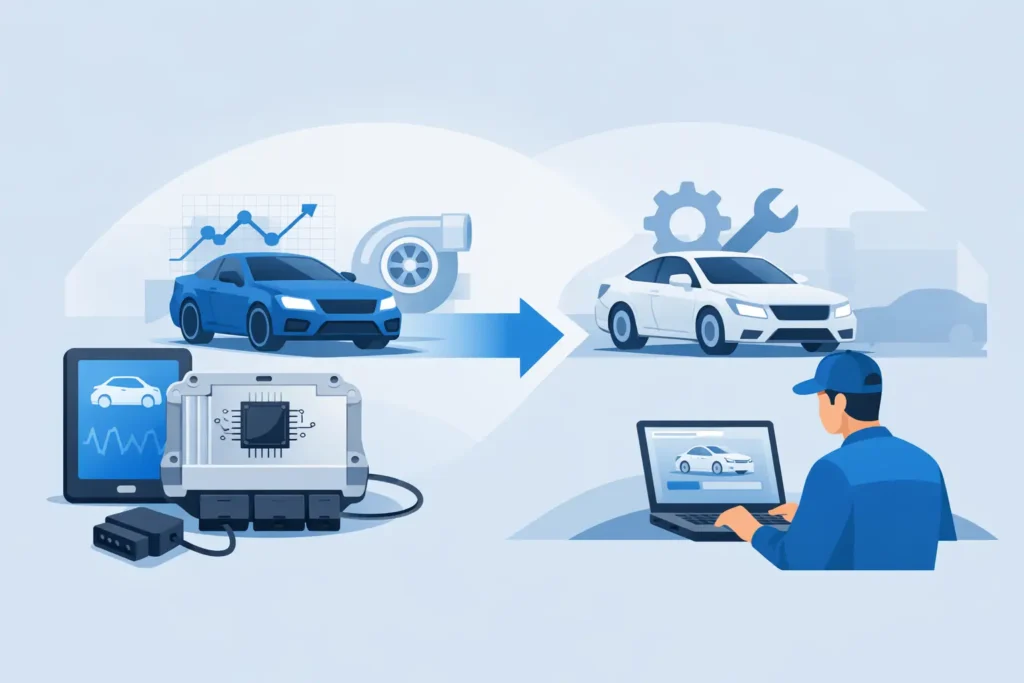
A previous owner’s remap, a warranty claim, a vehicle sale or a change in plans can all raise the same question: how to return ECU to stock without creating new faults. The answer is not simply to write any file labelled “original” back to the car. A proper return-to-stock service starts by identifying the ECU, checking its current software state and restoring a verified calibration that matches the vehicle.
For a modern petrol, diesel or commercial vehicle, ECU software controls far more than peak power. It can affect torque request, boost control, fuelling, injection timing, throttle response, gearbox torque intervention, exhaust gas temperature protection and fault-code strategy. Restoring it correctly protects drivability and avoids the problems that can follow a rushed or mismatched flash.
What returning an ECU to stock actually means
Returning an ECU to stock means reinstating the vehicle’s original manufacturer calibration, or a verified original-equipment software version appropriate for that exact ECU and vehicle. The aim is to remove an aftermarket calibration and put the engine management system back into a standard operating state.
That distinction matters. “Stock” does not always mean the same software version the vehicle left the factory with. Manufacturers issue updates throughout a model’s life to address emissions performance, cold starting, component protection, drivability and known faults. If the ECU was updated at a dealer before it was remapped, the correct stock file may be that later manufacturer version, not an older file sourced from another vehicle.
A quality restoration also preserves the coding, immobiliser data and configuration that belong to the car. These data areas can be critical on vehicles with multiple control modules, automatic gearboxes, start-stop systems, AdBlue systems or factory options that affect engine operation.
Why a generic stock file can cause problems
Two cars of the same model can use different ECU hardware, software numbers, injector configurations or emissions systems. A file that appears to suit a 2.0 diesel from the same year may still be wrong for the vehicle in front of you.
Writing an unsuitable file can lead to warning lights, non-start conditions, reduced-power mode, implausible sensor faults or communication errors. In more serious cases, an interrupted programming process or incompatible calibration can leave the ECU needing bench or boot-mode recovery.
This is why a return-to-stock job should begin with an ECU identification read. The technician should confirm the hardware number, software number, calibration identification, vehicle VIN where available and method of communication. On many vehicles this can be completed through the diagnostic port. Others require an alternative programming method because of ECU security, previous programming history or manufacturer protection.
A dealer software update is not automatically a substitute either. It may overwrite an aftermarket tune, but it can introduce a newer software level and may not resolve an underlying fault. It is also not the most practical route if your priority is restoring a known original file before selling the vehicle or changing calibration strategy.
When it makes sense to return ECU to stock
There are several sensible reasons to restore standard software. Selling a vehicle privately is a common one. Some buyers prefer an unmodified car, and returning it to stock can make the vehicle easier to assess, insure and maintain. Keep a record of the work, including the ECU identification and date of restoration, so the next owner has clear information.
Warranty work is another reason, although owners should be realistic. Returning the ECU to stock cannot guarantee that prior changes will be undetectable to a manufacturer, dealer or insurer. Modern diagnostic systems may record programming counters, software history, flash data or operating information. Honest disclosure is always the safest approach when a warranty or insurance position depends on modifications.
You may also want a stock calibration before diagnosing a fault. If a vehicle has poor boost control, high DPF differential pressure, fuel-pressure deviation, lambda errors, excessive smoke or high exhaust gas temperatures, standard software gives a technician a cleaner baseline. It does not make a mechanical problem disappear, but it removes uncertainty about whether the calibration is contributing to the symptoms.
For vans and fleet vehicles, a return to stock may be a practical operational decision. A business may need a consistent standard calibration across vehicles, or a new operator may have different insurance, payload or maintenance requirements. The right choice depends on the vehicle’s use, condition and who is responsible for it next.
The correct process for restoring original ECU software
The first stage is a health check, not a flash. A technician should scan all relevant modules for stored and pending fault codes, then look at live data where required. Battery voltage and power supply stability are checked before programming because a voltage drop during a write can cause avoidable ECU failure.
On a diesel vehicle, the assessment may include DPF pressure readings, exhaust temperature sensor plausibility, boost requested versus actual, air-mass readings and fuel-rail pressure. On petrol performance cars, ignition correction, lambda values, intake-air temperature, misfire counters and boost control can be relevant. The exact checks depend on the engine, ECU and reason for the restoration.
Once the vehicle is suitable for programming, the existing ECU data is read and saved where the method allows. This provides a record of the software currently installed and can be valuable if the vehicle’s history needs to be reviewed later. The technician then sources or verifies the correct original calibration against the ECU’s identification.
The stock file is written using suitable dealer-level or specialist programming equipment, with a stabilised power supply where required. After the programming cycle, the ECU is re-identified, fault codes are checked and cleared only where appropriate, and the vehicle is tested for normal starting, idle quality and response. A road assessment may be useful where safe and practical, particularly if the original concern involved limp mode, hesitation or warning lights.
The final result should be a vehicle that operates as the manufacturer intended for its current software version. That does not mean every existing issue will be cured. A worn turbo actuator, boost leak, sticking EGR valve, failed NOx sensor or overloaded DPF still needs diagnosis and repair on its own merits.
What to check before booking a return-to-stock service
Before arranging the work, gather the vehicle registration, make, model, year, engine size, fuel type and transmission type. If you know who performed the remap or have an invoice from the work, keep it available. An original file saved by the previous tuner can be useful, but it still needs checking against the vehicle’s current ECU identification.
It also helps to be clear about your reason for restoring the software. A vehicle being prepared for sale needs a different conversation from a car with an engine-management warning light. If the car has developed a fault after tuning, explain when the symptoms began, whether they occur cold or hot, and whether any repairs have already been carried out. That information directs the diagnostic process and reduces the risk of treating a mechanical issue as a software issue.
Do not erase fault codes immediately before an appointment. Stored codes and freeze-frame data can provide useful evidence about load, temperature and sensor readings when the fault occurred. Likewise, avoid fitting unrelated parts in the hope of solving a warning light before the vehicle has been assessed.
Can you return an ECU to stock yourself?
Some owners have access to handheld tuning devices that store an original read and offer a “restore original” function. If the device was used correctly, the battery is stable and the vehicle has not had an ECU update or replacement since, that can be a valid route. However, it is not risk-free.
The original read may not be complete on every ECU, particularly where modern protection requires a virtual read or specialist access. The file may have been lost, the battery may be weak, or a previous tuner may have used a different method. A cheap generic tool can also lack the protocols, checksum handling and recovery support needed for your ECU.
For most owners, particularly those with newer vehicles, modified diesels or business-critical vans, professional programming is the lower-risk option. A mobile technician can assess the car at home, at work or at an agreed location, provided there is safe access and sufficient power stability for the programming procedure.
Returning to stock does not bypass emissions or legal obligations
A genuine stock restoration should return emissions-related systems to their intended calibration strategy. It should not be confused with deleting DPF, EGR, SCR or other road-use emissions functions. If a vehicle has an emissions-system fault, diagnose the cause first. A blocked DPF, failed pressure sensor or wiring fault requires a repair-focused solution, not software that masks the problem.
Insurance is equally straightforward: tell your insurer about any current or previous modifications where their policy requires it. The rules vary between providers, and returning the ECU to standard does not remove the need to answer questions accurately.
Boostcore approaches return-to-stock programming with the same diagnostics-first process used for vehicle-specific tuning. The objective is not just to complete a write cycle. It is to confirm the ECU is healthy enough to programme, use suitable verified software and leave you with clear information about the vehicle’s state.
If you are unsure whether your car is remapped, start with an ECU identification and diagnostic assessment. It is a far better foundation than guessing what is already in the software – and it gives you a clear route back to standard operation when that is the right decision.