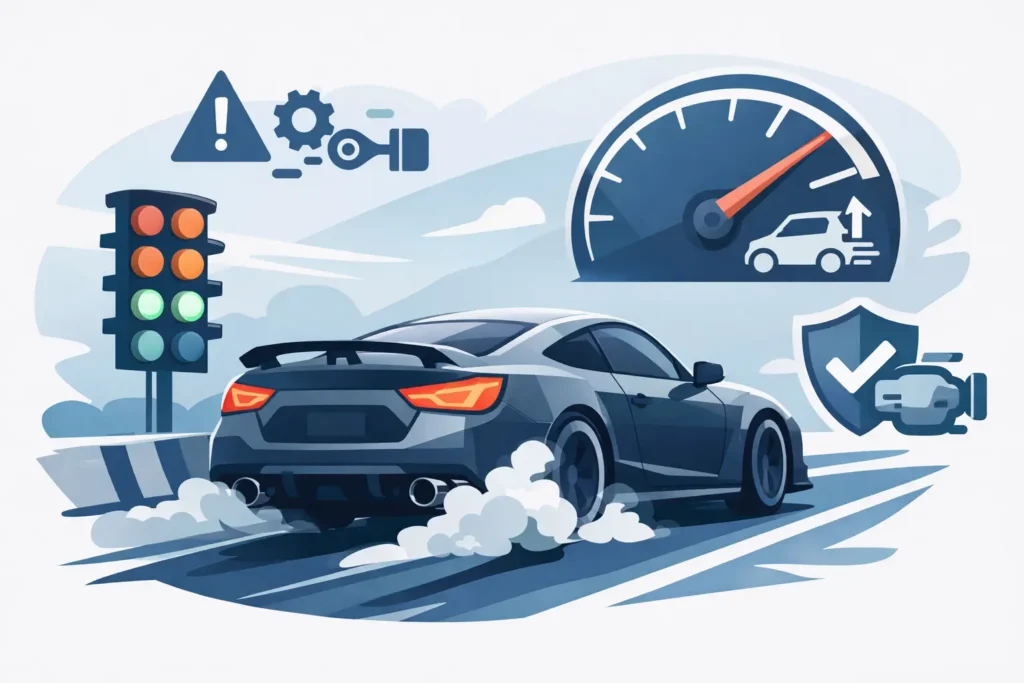
A standing start is one of the highest-load events a road car will experience. Engine torque arrives quickly, tyres must find grip, and the clutch, gearbox, driveshafts and differential have to absorb the transfer of force. So, is launch control safe for cars? It can be, but only when the vehicle, calibration and conditions are right. It is not a harmless button to use repeatedly on any car with a performance remap.
Launch control is best treated as a controlled performance function, not a measure of how hard a vehicle can be abused. A properly configured system can make acceleration more repeatable while maintaining sensible engine and driveline limits. An unsuitable setup can expose an existing weak clutch, tired tyre, worn mount or gearbox issue very quickly.
What launch control actually does
Launch control is an ECU strategy designed to manage engine speed and torque during a standing start. Depending on the vehicle and ECU, it may hold the engine at a chosen RPM when the throttle is fully applied, then control torque delivery once the clutch is released or an automatic transmission begins moving.
On turbocharged petrol vehicles, it may also manage boost response through ignition and fuelling changes. That is why some systems create pops, bangs or flames. Those effects are not the purpose of launch control, and an aggressive calibration that prioritises noise can add unnecessary exhaust gas temperature and stress to the turbocharger, catalytic converter or petrol particulate filter.
The useful part is consistency. Rather than trying to hold revs manually and feeding the clutch in differently each time, the ECU works to a defined target. A good calibration considers the engine’s torque curve, turbo response, gear ratios, drivetrain layout and available tyre grip. The best launch is rarely the one with the highest RPM.
Is launch control safe for cars with standard parts?
There is no universal yes or no. A standard vehicle in sound mechanical condition may tolerate occasional launches within the limits intended by its manufacturer. However, standard components are still subject to wear, and manufacturers that fit launch control normally build in their own safeguards around coolant temperature, gearbox temperature, clutch protection and repeat use.
A manual car with its original clutch is particularly dependent on condition. Launching requires controlled clutch slip, and that generates heat in the friction material and flywheel. If the clutch is already near its torque limit, slipping under acceleration, or carrying high mileage, launch control can turn a marginal component into a failed one. The same applies where a Stage 1 or Stage 2 calibration has raised low-end torque beyond what the clutch was designed to handle.
Dual-clutch and torque-converter automatic gearboxes can deliver very effective launches, but they are not immune from stress. Clutch pack temperatures, gearbox oil condition and transmission software matter. A gearbox that hesitates, jolts, has stored fault codes or shows excessive adaptation values needs diagnosis before any performance feature is considered.
Four-wheel drive can improve traction, but it does not make launches consequence-free. Greater grip transfers more load into the propshaft, transfer case, differential and driveshafts. Front-wheel-drive cars tend to expose wheelspin and wheel hop instead. Neither outcome is ideal: wheelspin wastes acceleration, while severe wheel hop can shock suspension bushes, engine mounts and driveline components.
The factors that decide whether it is sensible
Tyres are the first practical limit. Cold, worn, mismatched or low-quality tyres cannot use torque properly, even if the ECU calibration is well written. Tyre pressures, tread condition and road surface all change the result. Damp public roads, painted lines, loose gravel and uneven tarmac are poor places to test a standing-start function.
Vehicle health matters just as much. Before adding launch control, a diagnostics-first check should look for current and historic fault codes, boost leaks, fuelling irregularities, misfire counts and abnormal live data. On petrol engines, ignition coils, spark plugs, lambda readings and fuel trims can be relevant. On diesel vehicles, boost control, injector correction values, DPF pressure and EGT behaviour may need assessment before increasing torque or introducing specialist ECU features.
Engine and gearbox temperatures also matter. A cold engine has thicker oil and components that have not reached their intended operating clearances. Repeated launches when the engine, clutch or transmission is hot can be equally unwise. Safe use means allowing the vehicle to warm through fully, then avoiding repeated attempts that give the drivetrain no opportunity to cool.
Finally, the software must match the vehicle. Generic settings copied between ECUs are not responsible calibration. RPM targets, torque intervention and boost behaviour should be chosen for the specific engine, ECU software version, gearbox and modifications fitted. A car with a larger turbo, upgraded clutch and suitable tyres may need a different strategy from a standard daily-driven hatchback.
Why more RPM is not automatically faster
Many drivers associate launch control with high revs and dramatic exhaust noise. In practice, too much RPM often means wheelspin, clutch heat and slower forward progress. The correct target is the point where the engine can enter its useful torque range without overwhelming the tyres or driveline.
A front-wheel-drive turbo petrol car may launch better from a relatively modest RPM with a progressive torque request. A rear-wheel-drive car on performance tyres may use a different target. A diesel vehicle, with stronger torque lower in the rev range, usually requires a particularly measured approach. Delivering maximum torque too early can be hard on a clutch, dual-mass flywheel and driveshafts.
This is why headline figures alone do not determine suitability. Two cars with the same claimed BHP can behave very differently depending on tyre compound, differential type, vehicle weight, boost response and the shape of the torque curve. Usable performance is the objective, not a calibration designed for a single dramatic launch.
When launch control should be avoided
Do not use launch control to diagnose a problem or to see whether a clutch will survive. If the car has clutch slip, drivetrain vibration, knocking under load, inconsistent boost, a warning light, gearbox faults or tyre damage, those issues should be addressed first.
It should also be avoided on public roads. Hard launches reduce the margin for other road users, surface changes and unexpected loss of traction. Even where a vehicle is technically capable, a suitable private venue or controlled track environment is the responsible setting.
Repeated use is another red flag. One controlled launch on a healthy vehicle is very different from back-to-back attempts for social media clips or informal races. Heat builds in the clutch, transmission, tyres and turbo system. Some factory systems restrict consecutive launches for precisely this reason.
A sensible process before adding the feature
For a vehicle being considered for specialist ECU options, start with its current condition rather than the requested feature. Confirm the exact engine and ECU, check the service history, inspect tyre and clutch condition, and run a full diagnostic scan. Live data can then identify concerns that a fault-code scan alone may miss, such as boost deviation, unstable fuel trims or DPF loading.
The next decision is whether launch control suits how the vehicle is actually used. For a daily commuter, family car, van or fleet vehicle, stronger mid-range torque and improved throttle response may provide far more value with less stress. For a well-maintained performance car used occasionally at suitable events, a conservative launch strategy may be appropriate.
If fitted, the feature should be calibrated with protection in mind. That means a sensible RPM threshold, controlled torque delivery, no unnecessary anti-lag behaviour, and clear guidance on warm-up, tyre condition and frequency of use. Boostcore approaches specialist remap options on that vehicle-specific basis, with diagnostic checks completed before software changes are made.
The practical answer
Launch control is safe only in the same way any performance feature is safe: when it is correctly engineered, used sparingly and applied to a vehicle in suitable condition. It cannot repair poor maintenance, compensate for worn tyres or make a clutch and gearbox stronger than their physical limits.
If you are considering it, ask whether the car is healthy enough, whether the calibration will respect the drivetrain, and whether you have a legitimate place to use it. The right answer may be a conservative setup, a component upgrade first, or simply a well-calibrated torque map that makes the car quicker and easier to drive every day.