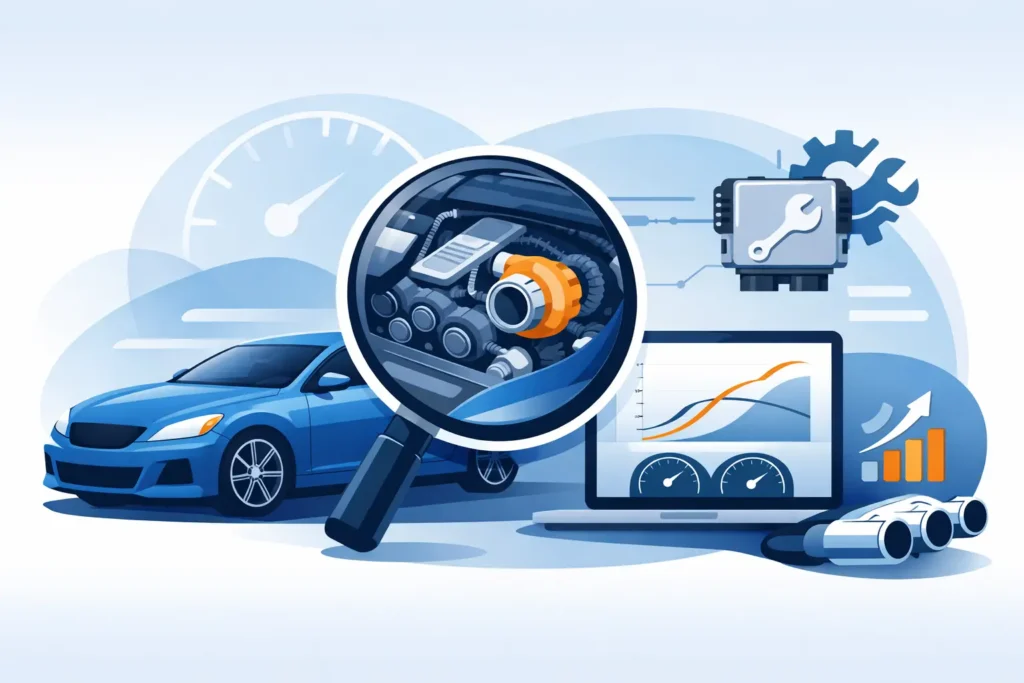
A Stage 1 remap should not begin with a laptop plugged into the diagnostic port. It should begin with the question: is this particular vehicle healthy enough to tune? When drivers ask what is included in a Stage 1 remap, the useful answer is more than a claimed BHP figure. A professionally delivered service combines vehicle checks, ECU identification, carefully calibrated software and post-remap verification, all matched to how the car or van is actually used.
For a daily-driven petrol car, that may mean sharper mid-range response for safer overtakes. For a diesel van working across Hampshire, it may mean stronger torque at lower revs, fewer unnecessary gear changes and more relaxed towing or loaded driving. The right outcome is usable performance, not a headline number at the expense of mechanical condition.
What is included in a Stage 1 remap?
A Stage 1 remap is an ECU software recalibration designed for a standard, mechanically sound vehicle running its original major hardware. It adjusts the parameters that control how the engine delivers power and torque, while retaining the vehicle’s factory hardware such as the turbocharger, injectors, intercooler, exhaust system and air intake.
The exact calibration depends on the engine, ECU type, current software version, fuel type and condition of the vehicle. Two cars with the same badge can have different ECUs or factory outputs, so there is no responsible one-file-fits-all approach. Final gains and availability must always be confirmed against the vehicle itself.
A proper Stage 1 service commonly includes a diagnostic assessment, an ECU read and backup, a vehicle-specific calibrated file, controlled programming, validation checks and clear advice on the vehicle’s new characteristics. It does not mean ignoring warning lights, masking faults or pushing a tired engine beyond what its data supports.
Diagnostics first: checking the vehicle before tuning
Pre-remap diagnostics are central to responsible ECU tuning. A vehicle can feel reasonably normal yet have stored fault codes, a small boost leak, poor fuelling correction or DPF loading that makes tuning unsuitable until the underlying issue is resolved.
The assessment starts by identifying the vehicle and its ECU, then checking for fault codes across relevant control modules. Depending on the engine and symptoms, live data may be reviewed for items such as requested and actual boost pressure, air mass readings, intake temperatures, coolant temperature, fuel pressure, lambda values on petrol engines, DPF differential pressure and regeneration status on diesels.
This matters because the ECU can only control within the limits of the hardware it is receiving information from. If a MAP sensor is reporting implausible boost, a vacuum hose is leaking, or the DPF is already heavily restricted, more torque is not the answer. The sensible route is diagnosis and repair first, then reassess whether a remap is appropriate.
Mileage alone does not decide suitability. A well-maintained higher-mileage vehicle with clean live data can be a better candidate than a lower-mileage example with poor servicing, unresolved faults or evidence of excessive smoke. Maintenance history, oil condition, clutch operation, tyre condition and the way the vehicle is used all form part of the practical picture.
ECU identification and original software backup
Before any software is changed, the ECU must be correctly identified. This confirms the hardware and software references required to select the correct calibration method and suitable Stage 1 file.
The original ECU software is read where the control unit allows and retained as a backup. This is important for traceability and gives the owner a route back to the factory calibration if circumstances change. Return-to-stock programming can be useful when selling a vehicle, changing insurance arrangements or returning a company vehicle to its original configuration.
Some ECUs can be programmed through the vehicle’s diagnostic port, while others require a bench or boot-mode process. The method is determined by the ECU and its security architecture, not by convenience. Stable voltage support is also essential during programming, as low battery voltage or an interrupted write process can create avoidable ECU problems.
The calibrated Stage 1 software
The remap itself is a recalibration of relevant engine-management maps. On a turbocharged petrol or diesel engine, these may include torque limiters, boost control, fuel delivery, throttle request, ignition timing on petrol engines, rail pressure and smoke limitation on diesels. The maps are adjusted as a coordinated set rather than simply raising one value.
The purpose is to make better use of the engine’s available operating range while preserving sensible safety strategies. A good calibration considers air temperature, exhaust gas temperature, fuelling, turbocharger operating limits and the torque capacity of the driveline. That is why calibration quality matters far more than an ambitious advertised figure.
For many turbo diesels, the most noticeable change is stronger torque through the middle of the rev range. This can make a loaded van, SUV or family car feel less strained on hills and when joining faster roads. Petrol turbo engines often gain a more immediate throttle response and stronger pull once boost is established. Naturally aspirated engines can still be improved in response and drivability, but their peak-power gains are usually more modest.
A Stage 1 remap is normally intended to work with standard hardware. If a vehicle has upgraded intake, exhaust, intercooler, turbocharger or fuelling components, it may need a custom calibration instead. Equally, a standard vehicle may not be suitable if its clutch, automatic gearbox, turbocharger or emissions system is already showing signs of wear.
Programming, checks and real-world validation
Once the correct file has been selected and the vehicle is approved for tuning, the ECU is programmed using professional equipment and a stable power supply. The technician then confirms that programming has completed correctly and checks the ECU communication and fault status again.
Post-remap checks are not merely a formality. They help confirm that requested boost and fuelling values are being achieved sensibly, that no new fault codes have appeared and that the vehicle responds as expected. Where conditions allow, a controlled road check can assess throttle response, torque delivery and any symptoms that require further investigation.
A mobile service brings this process to a home, workplace or agreed suitable location, but it should not mean cutting corners. There still needs to be enough time, safe space and battery condition to carry out the work correctly. If the vehicle is hot, has a warning light, cannot be safely tested or produces concerning live-data readings, postponing the remap can be the right decision.
What a Stage 1 remap does not include
Clarity prevents disappointment. A Stage 1 remap is not a mechanical repair, a guaranteed cure for poor fuel economy or a replacement for servicing. It will not fix a blocked DPF, worn injectors, slipping clutch, failing turbo actuator, damaged sensors or an existing gearbox fault.
It also does not automatically include hardware upgrades, dyno testing, transmission calibration or changes to emissions-control systems. Some vehicles benefit from additional gearbox software work, particularly where an automatic transmission has torque-management limits. Others do not need it. The recommendation should follow the vehicle specification and intended use, rather than being added as a generic extra.
Fuel economy can improve where extra low-to-mid-range torque allows lighter throttle inputs and earlier upshifts. That benefit depends entirely on driving style, journey type, load and traffic. Use the additional performance frequently and consumption may stay the same or increase. For fleet operators, the most meaningful measure is usually fuel use across comparable routes over several weeks, not one short journey after the remap.
Insurance, servicing and sensible ownership
A remap is a material modification and should be declared to your insurer. It is also sensible to keep service intervals disciplined, use the correct specification oil and address warning lights promptly. Petrol performance vehicles may require the fuel grade recommended for the calibration, while diesel owners should pay particular attention to DPF health, regular longer runs where appropriate and any signs of interrupted regeneration.
More torque can expose an already marginal clutch or dual-mass flywheel, especially on higher-mileage manual diesels. That does not make Stage 1 tuning inherently unsuitable, but it is a trade-off worth discussing before the work is carried out. A transparent technician will explain where a vehicle is a strong candidate and where repairs or a more conservative approach would be wiser.
Choosing the right result for your vehicle
The best Stage 1 remap is the one that suits the vehicle’s condition and the job it has to do. A commuter may want smoother overtaking performance. A tradesperson may prioritise loaded pulling power. A performance-car owner may value sharper response while still retaining civilised daily manners. Boostcore approaches this through diagnostics first and vehicle-specific calibration, rather than treating every engine as identical.
Before booking, be ready to share the registration, mileage, recent maintenance, modifications, warning lights and what you want the vehicle to do better. That conversation often provides the clearest indication of whether Stage 1 is the right route – and whether the vehicle needs attention before software is changed.